Slide-in vs. freestanding range — which is best for your kitchen?
Flush fit or flexible placement? Here's how to choose the right range for your space.

Edited by Tamara Aspeling•Home Improvement Expert•Last updated May 28, 2026
Tamara is a home improvement writer, trained construction estimator, and project manager with 25 years of experience.
Last updated May 28, 2026
Highlights
- Slide-in ranges fit between cabinets for a sleeker look, while freestanding ranges can stand apart from cabinetry or may stick out slightly from it.
- Choose a slide-in range for a seamless design, or a freestanding range for more flexibility around its placement.
- Your kitchen layout and countertop setup are the biggest factors in choosing the right range type.
- Slide-in models often have overlapping cooktops that prevent spills from dripping down the sides.
Understanding the difference between slide-in and freestanding ranges
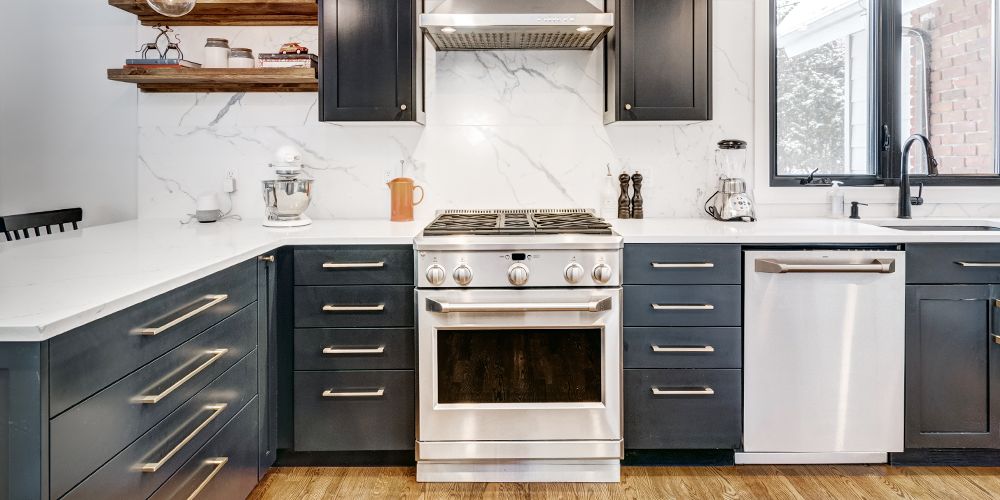
A slide-in range is designed to sit flush between your kitchen cabinets, creating a custom, built-in appearance. Its cooktop often slightly overlaps the counter to prevent food and liquids from spilling into the gap. Unlike a freestanding range, a slide-in model has unfinished sides and cannot stand on its own.
A freestanding range is an all-in-one appliance with finished sides so that you can place it anywhere in your kitchen, like beside your cabinets or all on its own. Its controls are typically located on a built-in back guard. Unlike a slide-in range, it doesn't require a custom cabinet cutout for installation.
Comparison at a glance:
While both ranges serve the same basic function, their design and installation requirements differ, affecting your kitchen's look and budget.
| Feature | Slide-in range | Freestanding range |
|---|---|---|
| Appearance | Sits flush with cabinets for a custom, built-in look | Finished sides allow it to stand alone as a complete unit |
| Placement | Fits between cabinets and requires a specific cutout | It can be placed anywhere, including at the end of cabinets |
| Installation | Requires precise cabinet and countertop measurements for a seamless fit | Slides into a standard-sized opening with no custom work needed |
| Controls | Located on the front, above the oven door | Typically located on a built-in backguard behind the cooktop |
| Spill protection | The cooktop overlaps the counter, preventing spills from dripping down the sides | Gaps between the range and counter can catch food and liquids |
| Costs | Typically has a higher upfront cost than freestanding models | Generally more budget-friendly with a wider range of price points |
How can you tell slide-in and freestanding ranges apart?
The main difference between a slide-in and a freestanding range comes down to how it's installed and where the controls are located.
- Placement: A slide-in range must be installed between cabinets, whereas a freestanding range can be installed anywhere.
- Appearance: Slide-in models sit flush with your countertops for a seamless, uninterrupted visual, while freestanding models will stand out and feel separate from the rest of your kitchen.
- Controls: The controls for a slide-in range are on the front, but a freestanding range typically has them on a backguard.
- Installation: A slide-in range requires a precise cabinet cutout, while a freestanding range needs a standard-sized space.
- Cleanup: The overlapping cooktop on many slide-in ranges prevents spills from dripping down the sides. Freestanding models don’t have this advantage.
- Cost: Slide-in ranges generally have a higher price point due to their built-in design, while freestanding ranges are often more budget-friendly.
What to expect with costs and upkeep
- The biggest cost driver is installation. Choosing a model that fits an existing space between your cabinetry will help you avoid expensive modifications.
- Energy consumption and advanced features like convection or induction also affect the price. Compare models to find the right balance for your budget.
Slide-in ranges often cost more upfront and may require professional installation, but their design helps prevent spills that could damage cabinets over time. Freestanding ranges are typically more budget-friendly and simpler to install, though they don't offer the same built-in spill protection.
Long-term durability and repair needs are generally comparable between the two types and depend more on the brand and features you choose.
Which one should you choose?
As a rule of thumb, a slide-in range is best for custom kitchens and remodels, while a freestanding range is a more flexible and budget-friendly choice for simple replacements.
You might want to choose a slide-in range if you're designing a new kitchen or doing a major remodel where you can plan for a custom fit. They are ideal for a seamless, high-end look that integrates directly with your countertops.
A freestanding range is a good option if you need a straightforward replacement for an existing unit and you won’t be modifying your cabinetry. Their finished sides give you more placement flexibility and they are typically more budget-friendly.
For more complex installations that involve custom cabinet cuts, countertop adjustments, or gas line connections, consult a professional appliance installer for the job.
Other appliances to consider
Cooktop: This is just the cooking surface that gets installed into your countertop, without an oven underneath. You might consider a cooktop if you plan to install a separate wall oven elsewhere in your kitchen. This option requires professional installation.
Wall oven: An oven built directly into your kitchen cabinets, separate from the cooktop. You'd choose this if you want the oven at a more accessible height and are planning a custom kitchen layout with a separate cooktop. Installation requires custom cabinetry and electrical work, so leave the project to a pro.
Rangetop: This is a professional-style cooking surface that sits on your counter and offers more powerful burners than a standard cooktop. It has front-facing controls but no oven, making it a good choice for serious cooks who are also installing a separate wall oven. Hire a pro to install this safely.
Drop-in range: This unit looks similar to a slide-in but rests on a cabinet base, requiring a strip of countertop in front and below it. Unlike other ranges, it lacks a bottom drawer for storage. Because they require very specific cabinetry, they are less common today, and installation is best left to a pro.
Professional-style range: This is a high-performance appliance that's typically wider (36 inches or more) and offers more powerful burners and oven features, mimicking a commercial range. You might choose one for a large kitchen if you're a passionate cook who needs top-tier performance. Their size, weight, and utility requirements mean you'll need a pro to install them.
Key takeaways
Choosing the right range comes down to your kitchen's design and your project's scope. A model that fits flush with your cabinets offers a seamless, built-in look perfect for new kitchens or major remodels. In contrast, a standalone unit offers greater placement flexibility and is often a more straightforward, budget-friendly replacement.
How it works.

Search.
Browse profiles, see prices and use filters to find pros who match your project.

Chat.
Contact the pros you like to discuss project details.

Hire.
Check pro availability and book appointments right in the app.
Find local pros for your project
Tell us what you're looking for and we'll show you pros right for the job, with prices.