How to clean your dishwasher filter
By Alyssa Chua•Last updated Aug 15, 2023
Last updated Aug 15, 2023
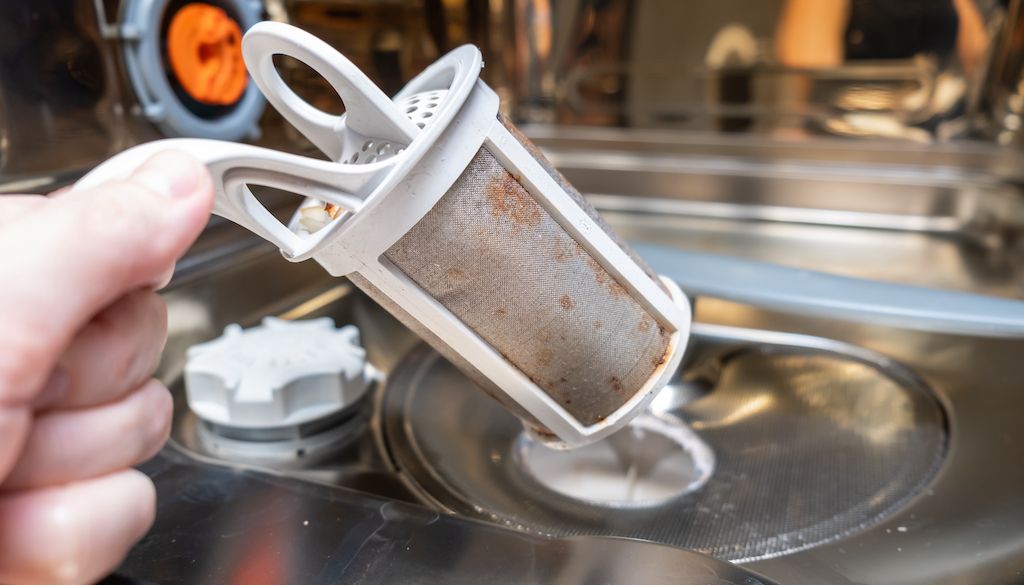
Wondering why your dishes are still dirty after running a cycle in the dishwasher? Is your appliance emitting a terrible smell? Or, is the dishwasher not draining properly? It could be that your filter isn’t clean.
It's important to periodically clean your dishwasher inside and out — including its filter. Don't know how? Read our guide to find out how to easily unclog and clean a dishwasher filter.
What is a dishwasher filter?
Your dishwasher filter keeps bits of food and grease from recirculating and dirtying your dishes again. But not all filters are the same.
For example, some older dishwashers have self-cleaning filters that act like garbage disposals. Some have a grinder that pulverizes food so it goes down the drain easily. Some have a fine mesh. Water pushes food through the mesh, breaking it into small pieces.
Check your owner's manual or the manufacturer’s website to find out what kind of filter you have. If you have a manual dishwasher filter, you must remove and clean it so your dishwasher stays in top condition.
How often do you clean your dishwasher filter?
Try to remove visible bits of food from the filter and the bottom of the dishwasher every time you use it. It's a good habit to develop if you want to prevent bad odors and drainage issues.
Every week, consider doing a deeper clean that includes removing the filter, rinsing and soaking it, and lightly scrubbing it.
5 steps to clean your dishwasher filter
Follow the steps below to clean your manual dishwasher filter.
Step 1: Locate the filter.

The filter usually sits at the bottom or back of the dishwasher. You’ll likely need to remove the bottom rack to access it. Look for a cage or grille, since that usually covers your dishwasher filter.
Your filter might be in the back corner of the dishwasher tub or under the bottom spray arm.
Step 2: Remove the filter.

Most dishwasher filters come out by hand: turn the cylindrical filter counterclockwise about a quarter turn until it unlocks, then lift it straight out. The flat screen underneath usually lifts free once the cylinder is out.
Some models secure the assembly with screws or clips instead, so check your owner's manual before forcing anything, and keep a screwdriver handy in case yours needs one.
Wear gloves and look before you reach in. Broken glass and bone fragments collect in the filter housing and are hard to spot against the stainless steel.
Step 3: Rinse the filter.

Hold your filter under the faucet to rinse off most debris. If smaller particles don’t rinse off easily, soak the filter in warm water and dish soap for a few minutes.
Gently scrub off excess debris with a soft brush. Don't use a scouring pad or wire brush. Both will tear the fine mesh, and a damaged filter lets food particles through to your pump.
Step 4: Return the filter.

Put the filter back into its slot. Turn it clockwise until it clicks or until the arrows align.
Make sure your dishwasher filter is locked before running the dishwasher. If your filter is loose, it could damage your dishwasher.
Step 5: Run the dishwasher.

Run a short cycle to confirm everything works. If the dishwasher drains normally and you don't hear rattling from a loose filter, you're all set.
How to keep your filter clean and clog-free

It's important to keep your dishwasher filter as clean as possible. To do so, remember these maintenance tips:
Remove food bits after every dishwashing cycle.
Every time you use your dishwasher, check for any leftover food that may have fallen into the filter. Remove the lower rack of your dishwasher. Look for food debris stuck in the filter or on the screen.
Deep clean your dishwasher filter once a week.
Pick a day each week to remove and clean the filter. Daily is overkill, but stretching it past a week lets grease and food residue harden onto the mesh, which makes it harder to scrub off later.
Follow the steps above to locate, remove, and clean the filter.
Do a monthly deep clean of your dishwasher.
Once a month, it’s crucial to get down and do a deep, thorough cleaning of your entire dishwasher. Clean it from top to bottom, inside and out. This is the best way to remove trapped particles, residue, grease, and other buildup. Be sure to wipe down the surfaces so every part stays clean.
When to contact a professional to fix your dishwasher filter
Cleaning your dishwasher filter is pretty easy to do. Just remove it, clean it, and pop it back in. But if you're experiencing other dishwasher issues and suspect you need repairs, it may be time to bring in a professional.
Download the Thumbtack app to connect with top-rated pros near you. You can find appliance repair pros, plumbers, handymen, house cleaners, and more to help with your home projects. Start receiving price quotes today.
FAQs
What happens if you don’t clean your dishwasher filter?
If you don’t clean your dishwasher filter, your dishes will never be completely clean. Think of it as washing your dishes with old soapy water and old food every time you run a cycle. Basically, you’ll end up eating off dirty dishes.
If you don’t clean your dishwasher filter, don’t be surprised to find food particles coating your dishes even after you run a clean cycle. You may also start smelling an unpleasant odor in your dishwasher — a sign that your dishwasher is unsanitary.
How many filters does a dishwasher have?
While the number of filters on your dishwasher varies, your dishwasher may have one or two pieces — a lower and upper filter assembly. One is cylindrical, and the other is flat. You should make sure to clean both.
Removing the cylindrical filter requires twisting and unlocking the mechanism that keeps it in place. The second filter, the flat one, comes out when you lift the first.
Is there a filter in all dishwashers?
Yes. Every dishwasher filters food debris out of the wash water — the difference is whether it does it for you. Self-cleaning filters, more common in dishwashers made before roughly 2010, grind food fine enough to flush down the drain and need no maintenance. Manual filters, standard in most newer machines, trap debris in a removable mesh you have to rinse yourself. Newer models went this direction because grinders are noisy.
If you don't know which you have, check your owner's manual, or pull out the bottom rack and look: a removable cylindrical piece you can twist means a manual filter.
How it works.

Search.
Browse profiles, see prices and use filters to find pros who match your project.

Chat.
Contact the pros you like to discuss project details.

Hire.
Check pro availability and book appointments right in the app.
Find local pros for your project
Tell us what you're looking for and we'll show you pros right for the job, with prices.